Friday, August 7, 2015

With Time Comes Experience

August 5, 2015

June and July were filled with work days, an unexpected celebrity moment, meeting of the new group, saying goodbye to the old group, a much need week of vacation, and an early addition.

An early addition to my host family that is.


Meet my newest tiniest host sister. She was born a month early and weighed only two pounds. In the picture above she is six weeks old. She is gaining weight and doing very well. I was shocked when I first saw how tiny she was and to learn she was only a month early. It was a very real reminder of how malnutrition continues to be a big problem in the rural parts of Panama. 

June consisted of meeting the new volunteers from group 76 (I’m in group 75) whom are in my same province. This was visual confirmation that we (group 75) are no longer the newbies! This was followed later in the month by celebrating being in country one year. An entire year in Panama, I can’t believe it. It feels like yesterday we were stepping off that plane into the humid Panamanian air with fear and excitement flowing fresh in our veins and every other sentence out of our mouths a question. (Now that I think about it I'm still uttering a lot of questions, but mostly in the form of: "como?" meaning; huh?/what?/could you repeat that cause you are talking way to fast and/or mumbled and I have no idea what Spanish words are coming out of your mouth.) 
I was reminded of this newness and excitement when I hosted one of the new trainees (from group 77, arrived in June, the new set of agriculture and environmental health volunteers) for a week in my site. It was a little surreal to realize I was now supposed to know what I’m doing and impart my year of experience and knowledge on a member of the incoming group. We spent the week working on projects, visiting families, and working in my garden. She survived living with a stranger for a week in a pea-sized house and ate every campo delicacy I conjured up without so much of a peep of complaint. What a trooper, I have high hopes for her next two years of service. One of the fun things week did that week was hike to the waterfall in my community.


My "desk" for the weekly reading program I have for the kids

We also got some pretty good picture of toucans. (Taken from my front porch.)


Yet another reminder that we are no longer the new kids of the block was having to say goodbye to the old group (73, the group that was here a year when we (group 75) showed up) of agriculture volunteers. It was particularly heart wrenching to say goodbye to a couple whose site was pretty close to mine and helped me tremendously in so many ways through my first year of service. I’m still not sure how I’m going to survive the next year without them.


On a lighter note, I was informed by someone in the office (i.e. someone with daily access to the news) that I was in a photo in a Panamanian newspaper! The article is about how a new school is being built in my community and every material needed for the construction has to be hiked in from the road.

See me in the top picture to the right?
 
I took a week of vacation and was able to spend time relaxing with family and exploring a tropical paradise.

 
Some of you might have assumed Panama is a tropical paradise... tropical? Yes. Is my site beautiful? Absolutely. However living in a house the size of a shoebox with no electricity or indoor plumbing or cell phone service does not a “paradise” make. I love my community, but I also loved spending a week with amenities and stuffing my face with American food.

Work projects in my site are continuing to evolve and grow, but more on that will come later, for now here are some pictures from June and July.


Fish Tank Construction

Coffee Pruning
 

Monday, July 6, 2015

May (in a nut shell)

 
A Priest came from the big city to baptize children. This was a pretty big deal because of how remote my community is.


Nothing can wake a serious nap taker.


I got started on two more fish tank projects.


My weekly reading club is a continuing success. 
 
Receiving her first prize for the hard work she does each week.

Monday, June 22, 2015

Developing Work

(Written April 28, 2015)

This month has been very productive! (I am actually writing the April blog post when it’s still April!) I feel like I’ve finally gotten into a real routine and I only spent three nights out of sight this month, because the work level in my community is finally starting to grow. I have had several trainings/field applications/work days on the topics of coffee pruning and fish tanks. One of the coffee pruning days I was accompanied by a member of the community I had already had a training session with. I was pleasantly surprised when he reminded the man I was training to bring an ingredient to the farm that is often overlooked, but is a very important part of the pruning process. Later that morning I felt a little useless as these two men went around the farm and pruned coffee trees. I uncomfortably stood around feeling like I was not doing my part, I was not helping, not contributing. Then it dawned on me; this is a good thing. This is what is supposed to be happening. This is what sustainability looks like. When I leave I won’t be here to train new people or to encourage a little more work upfront that will make their lives better in the long run. After all, the main goal of a development worker is to work themselves out of a job.

I had a government organization come and give a training on culantro production. A different government organization and the area’s representative come and assess the needs for constructing a road (widening the current foot trail) to the community.
 
I have held a weekly reading club for the children in my community. Once a week they come to my house and we read books for hours. Then each child chooses a book and answers the following questions: what is the name of the book? Summarize the story in three or more sentences. What was your favorite part? I have to work one-on-one with the children to actually try to get them to critically think about what they read. All they want to do is copy sentences straight for the book (this is how they are taught in school). It is a slow process, but I believe progress is being made. The children absolutely love the books. They are constantly coming to my house asking to read the books. After all, these books are the only story books they have in the community and I would safely bet the first many of them have seen.


In terms of personal garden improvements: I have finished my terraces, started watermelon, squash, beets, eggplant, green onions, and celery. I hauled bags of sawdust for mulch (and my latrine) and large wooden boards that were freshly cut so I can build another raised bed. I built my worm box, hauled cow poop, and successfully obtained California red worms that are currently turning that cow poop into beautiful compost. My tomato plants are looking good and producing several little green orbs. I hope to soon be eating delicious vegetables picked right outside my door.


One afternoon I went down to make banana bread with the teacher. This method of baking over a fire involves putting the pot full of banana bread mix (or whatever) on top of an empty tuna can inside another, larger pot with a lid. AKA the double paila (large pan). I did this for my birthday at my host family’s house and it turned out a little gooey in the middle and burnt around the edges, but the in-between was delicious. Everything was going according to plan until I heard the teacher (who was passing by the fire) start laughing... She then came to tell me that the tuna can fell. I was very confused (as I normally am when trying to make sense of Spanish) as to what this meant. I go to look at the pots and don’t see how she could tell that the tuna can had fallen. I ask her and she points below the pot, I bend over and this is what I see:


Yep, the tuna can had fallen alright, right through the hole I had just burned through the bottom of the pot. There was lots of laughing and me shaking my head thinking; of course this would happen. The banana bread was burnt around the edges and gooey in the middle. The parts picked out tasted of bitter failure. I bought a new pot for the school and took the one with the hole in it up to my house to hide the evidence. It currently has lemongrass planted in it.

 
Also this month my original host mom and two of my host sisters (my first host family I lived with for nine weeks during training) came to visit me in my site. It was very sweet for them to come and see my site. It also felt a little backwards being the host for them. Especially in terms of food. I cooked all the meals and couldn’t help thinking; are they going to like it? Did I make enough? Did I wait too long between meals? Did they starve the entire time they were here? It was a very weird role reversal and for the first time had me wondering if they thought the same things when I lived with them.

I would like to finish by giving a quick shout-out to best friends. When I actually get to talk to them I feel a little less crazy, a little more sureof myself, and very appreciative. I cannot accurately express in words the value of a best friend.

Saturday, May 23, 2015

Bathing in a puddle

The last week in March I ventured out to the Comarca Ngöbe-Buglé (CNB) to assist a few (non-agriculture) volunteers with agricultural related doings. I also got to see a different part of the country, not only geographically but also culturally. The CNB is one of (and the largest) Indian reservations in Panama. A large portion of PCV serve in the CNB in Panama. I visited three Environmental Health volunteers whose main projects are building aqueduct systems or latrines with their communities. It was fascinating to see such big cultural differences between their Indigenous sites and my Latino site. Women in the CNB wear traditional naguas, colorful dresses with embroidered details. They also speak their own language, but the majority can speak Spanish as well (Spanish is taught/used in schools). A lot of the CNB has been disforested due to population growth and unsustainable clearing practices. Each volunteer I visited, did not have an aqueduct (not surprising because that’s why they are there), which meant my showering experience was very different from at home in my community. Either out of a bucket or a “stream” a small cup was used to trickle water over myself in vain attempts to feel cleaner. I put “stream” in quotations because I visited during the dry season. Meaning it hadn’t rained in upwards of four months (very different from my site, it rained every three days or so during the dry season) and these “streams” were no more than a dribble of water that slowly filled up a small rock pool in the streambed. The water was not crystal clear or plentiful, it was like bathing in a puddle. If I had a site like this it is safe to say I would no longer have long hair.

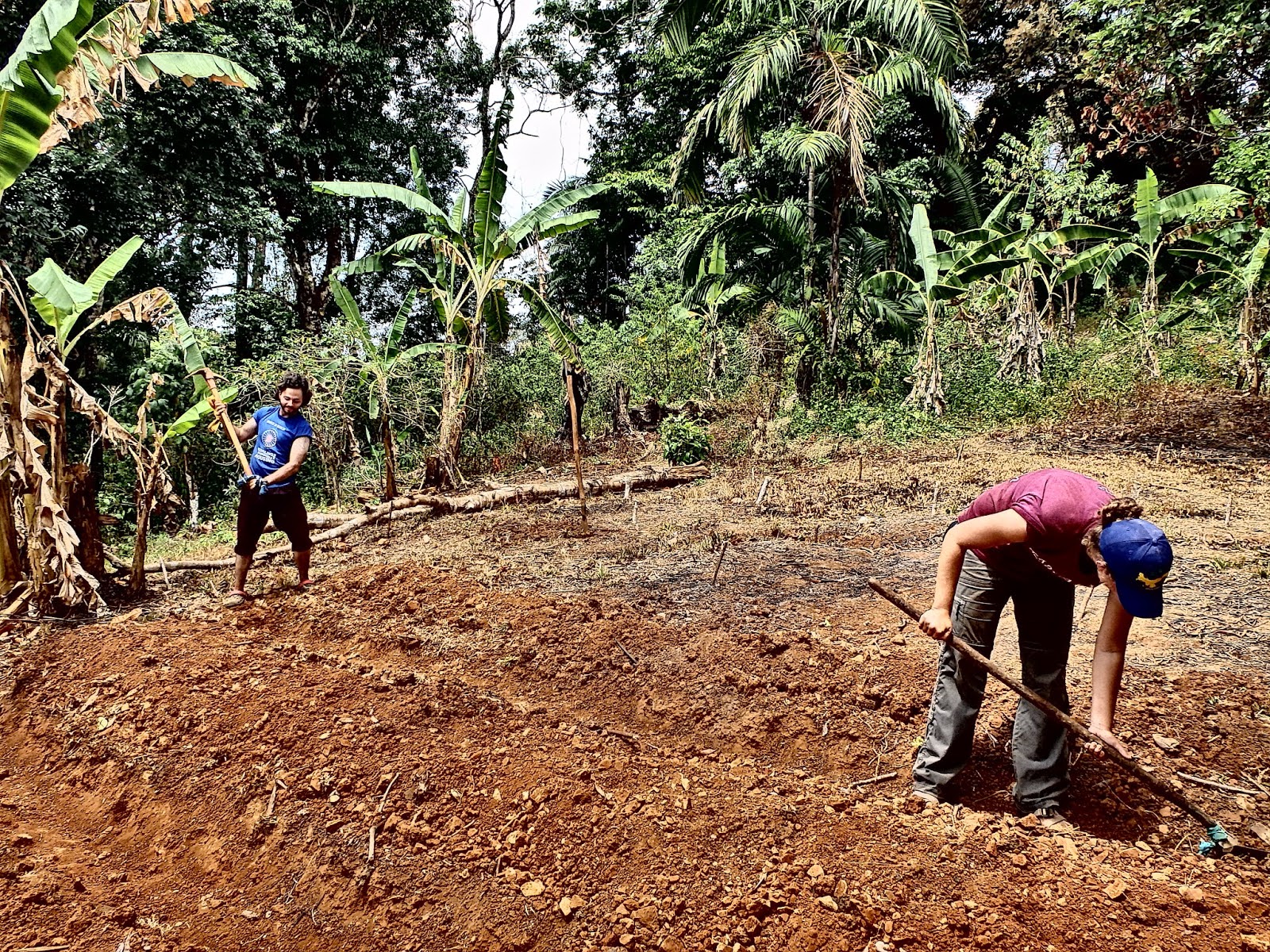
One of the biggest work days was helping one volunteer prepare his garden space. It was sweaty, gratifying, painful (my hands were covered in blisters), and productive.


Tripping and stumbling and turning my ankles is a pretty standard occurrence, but actually falling thankfully doesn't happen that often, but on the last day of my travels I fell straight on my knee. I got it taped up to help with the massive amounts of bruising and all was well.